Barefoot or shod horses? What’s best?
I tested the two scenarios!
I’ll share my experience with you
When I considered going barefoot in 2011, she was 7 years old and had just finished her year of dressage and amateur show jumping.
I assessed 2 trimming methods:
- The Strasser method, which I immediately ruled out since the practitioner told me that the conditions for removing iron were also to no longer clip it, nor rug her out, nor stable at all;
- The KC Lapierre method which set no conditions and simply warned me that I could not jump or go outside for weeks after taking the shoes off.
The 2 photos below show the feet of my mare after going barefoot in March 2011 at 7 years old after 3 years of shoeing. She was a more show jumping-oriented mare; she was stabled during the night on shavings from mid autumn through to mid spring and full time in the paddock the rest of the year.
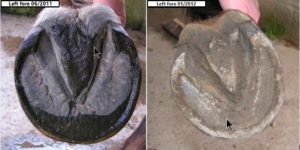
Sport horse barefoot
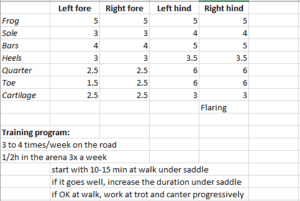
Hoof assessment KC Lapierre: grid
To follow the evolution of the bare foot, the trimmer showed me all the elements of the foot to assess that I should follow at each trimming. It was very instructive for me to study the foot in detail and follow what needed to improve and what didn’t.
The good things about keeping ridden horses barefoot
- The best thing ever is to ensure the horse’s welfare
- No odd shaped hooves on the long run
- No need to worry about a horse losing his shoe the day before a major event
- It results way cheaper to maintain a barefoot horse
- Less damage due to a horse kicking (another horse or the rider)
- Better gripping, mainly on slippery surfaces like roads.
- Better proprioception and locomotion
The bad things about keeping ridden horses barefoot
- Horses cannot stand in dirty stables with wet manure
- Harder to go for a long ride on a ground the horse is not prepared for (unless he wear boots)
- It will take longer to an adult horse that has been shod for long to get used to being barefoot
- It can sometimes result tricky to find a competent trimmer in the area
- The diet must contain as little sugar as possible
As a conclusion, I would say that the first thing is to figure out when is the best moment for the horse to go barefoot (both for the horse and for the owner), knowing that there will be a more or less long adaptation period, depending on the age of the horse and the quality of its hooves. I highly recommend finding the right professional in your area before going barefoot. Under no circumstances should the horse show signs of depression – even less develop abscesses – after trimming. Unfortunately, these are the feedback I have had from various people who have used the Strasser method; I’m not saying this method is to be banned but you should keep in mind big changes may affect the horse.
If, for some reason, I was unable to keep my horse barefoot, I would opt for the Duplo shoe solution because they seem to me to be a very good alternative, they allow in particular an excellent grip on the road (https://duplo-frank.de/fr/avantages) , this is what some Mounted Police use.
Did you know similar observations had been made in us humans by Ken Bob Saxton who advocates barefoot running??
Interview with Barefoot Ken Bob Saxton
So if this is true for us who use padded, wedge, inflated shoes, how can it be wrong for feet weighted with pieces of nailed iron shoes?!?
Link to some professional trainers/riders who decided to keep their ridden horses barefoot:
- Julien Epaillard, 5-star show jumping rider and currently best French in the FEI world ranking: https://www.pressreader.com/uk/horse-hound/20200604/282711934251340
- Simon Earle Racing, “alternative” steeple chase trainer in the UK: https://nakedhorse.wordpress.com/tag/simon-earle/
- Luca Maria Moneta, 5-star Italian show jumping rider and Pat Parelli student: https://lucamoneta.com/?lang=en
- Kate Hewlett and Timothy Featherstone, Kate’s riding centre owners and managers in Kerikeri New-Zealand: http://www.katesridingcentre.co.nz/
- Serena Gordon British dressage Grand Prix rider: https://www.larkfielddressage.com/
- Royston Carr (thoroughbred horse traininer) who has had horses barefoot for 20 years: https://www.youtube.com/watch?reload=9&v=Ood8TiHG3TY