It is the rider himself who transmits the anxiety to the horse
How does the rider’s fear contaminates the horse?
I will offer you a series of 4 articles where I list the errors to avoid if you want to easily get a horse into a trailer:
- Error #1 : the leader keeps requesting when this one thinks of going in.
- Error #2 : the horse backs up really quickly and end up hitting his head in the ceiling of the trailer
- Error #3 : too many people around the horse give inconsistent commands
- Error #4 : the horse leader/owner passes on his stress to the horse due to an important stake (e.g. competition, tight schedule, etc)
You have all heard that horses feel fear! So it’s good to know that, but above all it’s very important to try to overcome this fear. And someone who tells you, “Don’t be afraid, calm down! Is not likely to help you much. So how do you calm a nervous horse before boarding? And above all, how to reassure him in a few minutes without transmitting his nervousness to him?
So what exactly happens in your body when you are afraid and the horse perceives so well?!?

1. Since the 80s, it is well known that it is always the same muscles used on the human face in an emotion of fear (not feigned). Here is an article on this topic by University of Sussex: Horses can read human emotions, study shows. The horse is fully capable of reading the fear on your face.
2. When you’re scared, your sympathetic nervous system goes on alert and increases your heart rate to prepare you for the escape, even if you don’t have to. So the horse doesn’t just measure your pulse, it is much stronger than that! In fact, he is able to sense heart rate variability, that is, the random speeding up and slowing down of the heart. And what happens then? You pass this disorder on to him and he too goes into heart disorder.
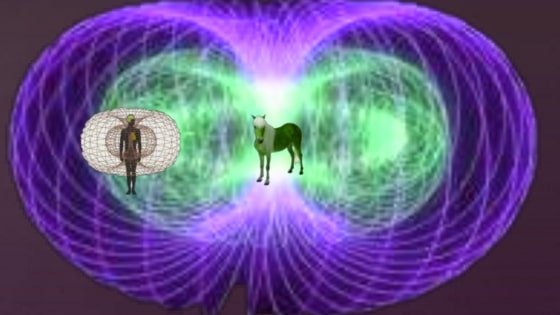
Our electromagnetic field impacts that of people nearby and vice versa; that of a horse is 5 times more powerful than that of humans and can reach up to 9 meters.
When horses are in cardiac coherence (in the paddock with their mates for instance), they naturally bring us to cardiac coherence state. Are we able to do the same to them? The good news is that it is possible and it is up to you to pass it on by practicing cardiac coherence!
But what exactly is this cardiac/heart coherence? This is precisely what the horse practices all the time (without knowing it) when it grazes quietly. And that’s exactly why you feel good with him! Because, yes, it is contagious !!
If you want to be able to calm a horse down, you will first have to practice on your own. I use the Cardiac coherence app to train from time to time; but just because your breathing is in sync with the app ball doesn’t mean you are necessarily consistent. The only way is to control the synchronization of the heart rate with the breath, which can be done with a pulse sensor (usually placed on the earlobe).
Some practitioners have a biofeedback device to measure the level of cardiac coherence you are able to achieve. I got it myself, and out of about ten people I tested, I found that the ones with the best consistency results are the people who regularly practice a meditation activity.
In the same way that it is useless to hope that an exercise that you cannot do at home will ultimately be easy outside, it is utopian to think that you will manage to achieve consistency on the day of a stressful situation (boarding a van, competition, etc.) if you cannot do it on your own on a normal day in a quiet place.
That’s why you need to practice!